










Fiverr’s CEO Said “AI Is Coming” Then Fired 30% of His Staff. But the Real Loss Was Something Else.
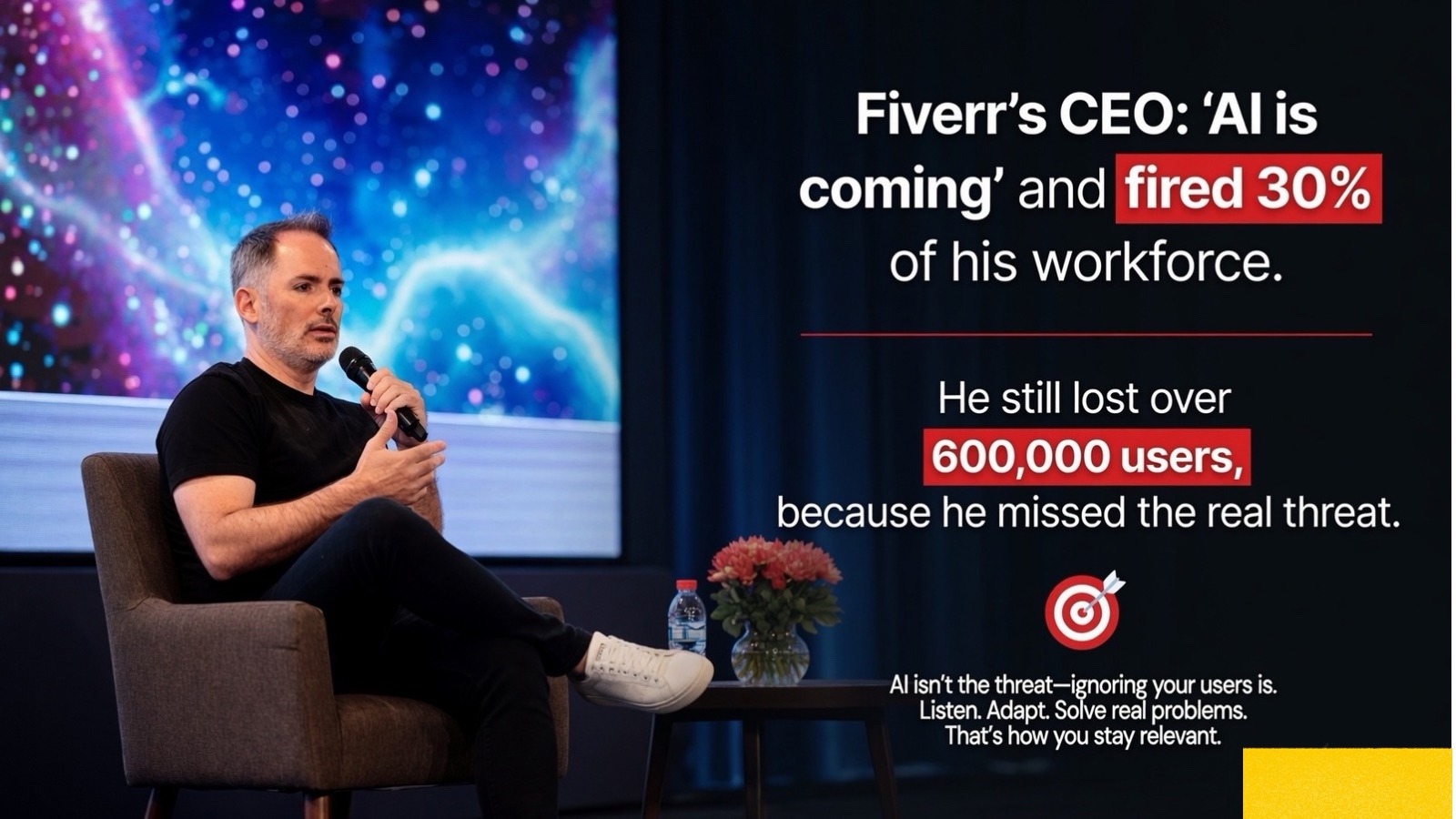
The Warning That Became a Betrayal
In May 2025, Fiverr CEO Micha Kaufman sent a company-wide email to his employees.
The message was blunt:
“AI is coming for your jobs. Heck, it’s coming for my job too. This is a wake-up call.”
Employees likely thought their CEO was being transparent. Looking out for them. Giving them time to prepare.
Four months later, they found out what he really meant.
250 People. One X Post. No Warning.
Fiverr laid off 250 employees roughly 30% of its entire workforce. CEO Micha Kaufman made the announcement through an essay posted on X.
Kaufman called it a “painful reset.” He said the goal was to make Fiverr “leaner, faster, and AI-focused” fewer people, greater productivity, and fewer layers of management.
The irony was impossible to miss.
Fiverr is a platform built to help freelancers find work the very workers whose livelihoods are already under threat from AI. And now the company was firing its own employees for the same reason.
The Numbers Tell a Darker Story
The layoffs made headlines. But quietly, something far more damaging was already happening.
Fiverr’s annual active buyers fell to 3.1 million by December 2025, down from 3.6 million in December 2024 a year-over-year decline of 13.6%.
That is over 500,000 users gone in a single year.
And this was not sudden.
The downward trend in active buyers had started as far back as the second quarter of 2023. By September 2024, active buyers had dropped to 3.8 million from 4.2 million a year earlier a 9% decline.
The platform was bleeding users long before Kaufman picked up the AI banner.
Revenue Grew. Users Fled. That Is a Red Flag.
Here is where the story gets complicated.
Fiverr’s revenue in 2025 reached $430.9 million, up from $391.5 million in 2024 a 10% increase. Spend per buyer also rose from $302 to $342 over the same period.
So the users who stayed are spending more. That looks good on a quarterly report.
But fewer and fewer new users are coming in. When the loyal base eventually moves on, there will be no one left to replace them. Revenue growth built on a shrinking user base is not a strategy it is a countdown.
He Read the Technology. He Missed the People.
This is the real lesson buried inside Fiverr’s story.
Kaufman correctly identified that AI was changing the industry. He moved fast, restructured aggressively, and cut costs ahead of schedule. The company even announced it expected to hit its 25% profit margin target in 2026, a full year ahead of plan.
But while he was watching the technology, he stopped watching his users.
Fiverr’s entire business depends on freelancers delivering value to buyers. When AI tools became cheap and accessible, small businesses started asking a simple question: “Why do I need to hire a freelancer when AI can do this faster and cheaper?”
Fiverr automated itself internally. It never solved that question for the people it was supposed to serve.
The Lesson One Line Can Teach
The image circulating on social media puts it perfectly:
“AI isn’t the threat ignoring your users is. Listen. Adapt. Solve real problems. That’s how you stay relevant.”
That is not anti-AI thinking. It is just good business.
Technology can make you efficient. It cannot make you irreplaceable. Only solving real problems for real people does that.
Fiverr optimized for speed and margins. It forgot to optimize for trust.
The Bottom Line
Micha Kaufman’s story is a cautionary tale for every leader rushing to become “AI-first.”
Cutting costs and embracing AI are not wrong moves. But when you do it by ignoring the people around you your employees, your users, your community the market has a way of sending the bill.
Fiverr lost 250 employees to layoffs. It lost over 500,000 active users in just one year.
The AI pivot may have saved money in the short run.
But the trust it cost may take years to rebuild if it can be rebuilt at all.
Share this content: